
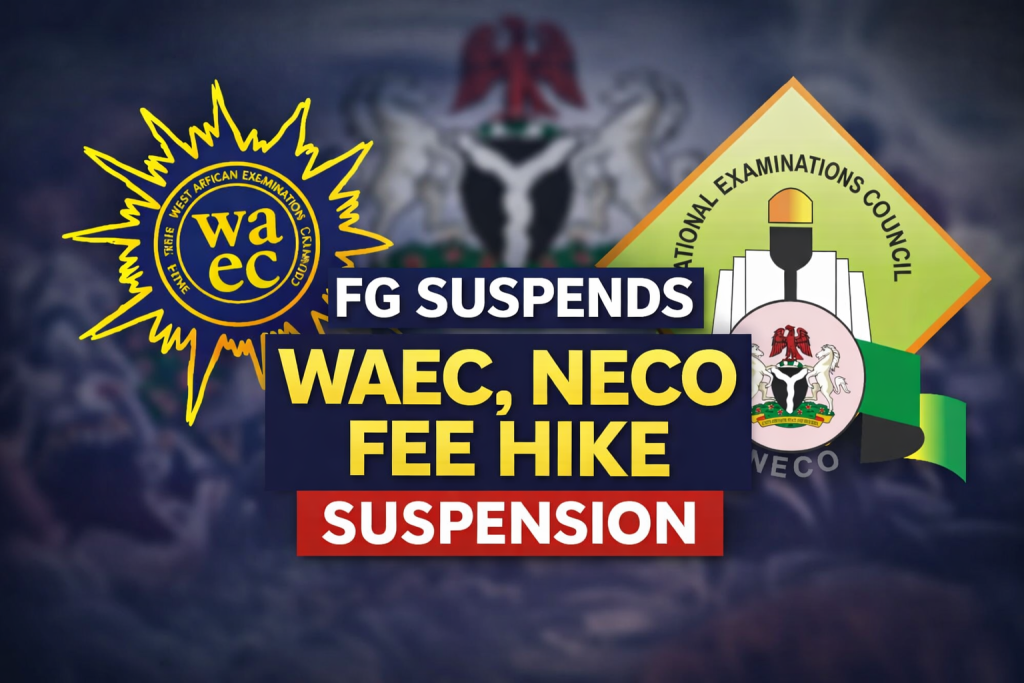
The Federal Government has suspended the proposed WAEC, NECO fee hike, halting the planned increase in registration fees for the West African Senior School Certificate Examination (WASSCE) and the National Examinations Council (NECO) Senior School Certificate Examination (SSCE). This decision came after widespread concerns from stakeholders and demonstrates the government’s commitment to inclusive and transparent policymaking. The announcement has sparked extensive discussion across the education sector, as the WAEC, NECO fee hike would have represented a major shift in examination costs for Nigerian students.
Quick Navigation
Background to the Proposed WAEC, NECO Fee Hike
In June 2026, the Federal Ministry of Education approved a uniform registration fee of N50,000 for WAEC and NECO examinations beginning in 2027. This represented an 82 percent increase from the existing fee of N27,500. The justification for the hike was rooted in rising operational costs associated with conducting national examinations. These costs included logistics, security, printing of examination materials, deployment of technology, and quality assurance measures necessary to maintain the credibility of public examinations.
The ministry explained that examination fees had remained largely unchanged for several years despite escalating expenses. As a result, examination bodies such as WAEC had requested an upward review to ensure sustainability. However, the announcement was met with strong opposition from parents, students, and civil society groups who argued that the increase would place an undue financial burden on families already grappling with economic challenges.
Public Reaction and Opposition
The proposed WAEC, NECO fee hike quickly drew criticism from various quarters. Former Vice President Atiku Abubakar publicly condemned the decision, describing it as insensitive to the plight of ordinary Nigerians. The National Association of Nigerian Students (NANS) also rejected the move, warning that it could further limit access to education for students from low-income backgrounds. Parents’ associations and organized labour voiced similar concerns, stressing that education should remain affordable and accessible to all.
The backlash highlighted the broader issue of affordability in Nigeria’s education system. Many families already struggle to meet the costs of schooling, and an abrupt increase in examination fees risked excluding thousands of students from completing their secondary education. The strong opposition underscored the need for government policies to balance financial sustainability with social equity.
Government’s Response and Suspension
In response to the widespread criticism, the Federal Ministry of Education issued a statement announcing the suspension of the proposed fee hike. The statement, signed by the Director of Press and Public Relations, Boriowo Folasade, confirmed that the letter conveying the fee adjustment had been withdrawn. The ministry emphasized that the decision was taken to allow for broader consultations with stakeholders before any final determination is made.
Minister of Education, Dr. Maruf Tunji Alausa, directed that the proposal be put on hold in line with the Federal Government’s commitment to evidence-based policymaking. He stressed that policies affecting students and their families must be carefully considered to ensure they serve the public interest. The ministry reiterated that students’ welfare, equitable access to quality education, and responsible policymaking remain central to the government’s education agenda.
Next Steps and Stakeholder Engagement
The suspension of the WAEC, NECO fee hike opens the door for extensive consultations with key stakeholders. The ministry announced that discussions would be held with examination bodies, state ministries of education, school proprietors, administrators, parents’ associations, organized labour, and other critical partners. These consultations are expected to provide a platform for diverse perspectives and help shape a policy that balances financial realities with the need to protect students’ access to education.
The government pledged to keep the public informed throughout the consultation process, underscoring its commitment to transparency. While the suspension provides temporary relief for families, the future of examination fees remains uncertain. The outcome of the consultations will determine whether the proposed hike is modified, delayed, or scrapped entirely.
Implications for Students and Families
The suspension of the WAEC, NECO fee hike is a welcome development for students and families across Nigeria. For many households, the proposed increase would have posed a significant financial challenge. By halting the implementation, the government has signaled its willingness to listen to public concerns and prioritize inclusivity in policymaking.
However, the underlying issue of rising examination costs remains unresolved. Examination bodies continue to face increasing expenses, and without a sustainable funding model, the quality and credibility of national examinations could be at risk. The challenge for policymakers will be to find a solution that ensures financial sustainability while safeguarding access to education for all students.