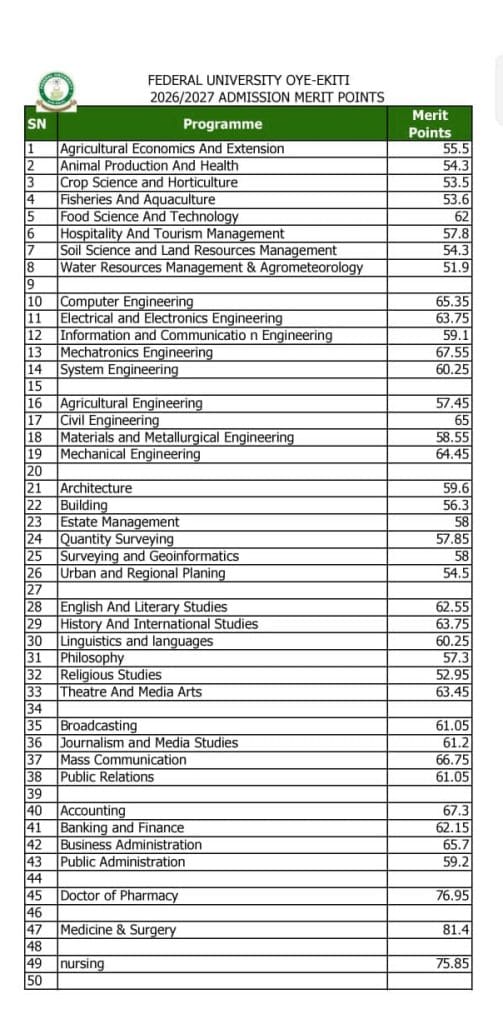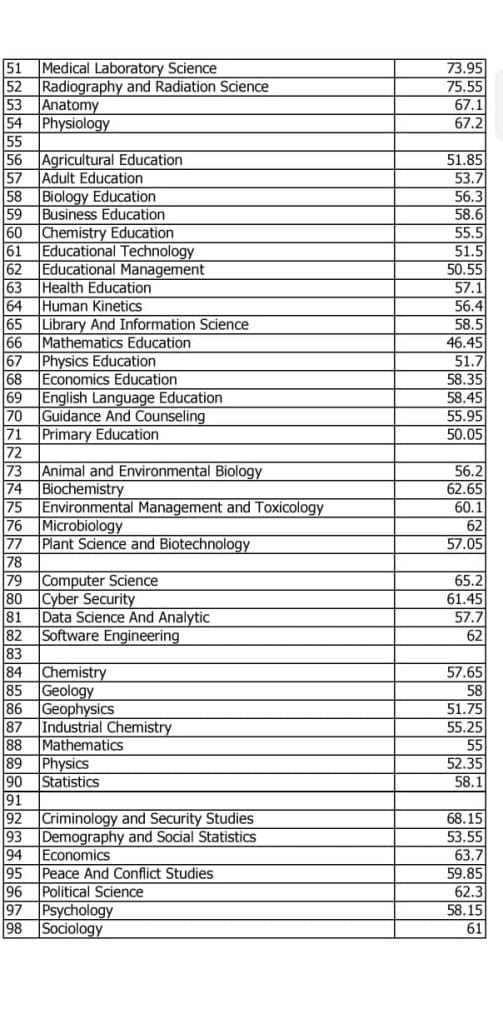

The management of the Federal University, Oye-Ekiti (FUOYE) has released the official Merit Admission Cut-Off Marks for the 2026/2027 academic session. This announcement is a key milestone in the institution’s admission process, as it provides clarity on the minimum scores required for entry into various programmes.

The FUOYE Admission Cut-Off Marks are determined annually and serve as benchmarks for merit-based admission. They reflect the competitiveness of each programme and the performance of candidates in national examinations. For many applicants, the release of these cut-off marks is the definitive guide to understanding their chances of securing admission into FUOYE.
Quick Navigation
Purpose of FUOYE Admission Cut-Off Marks
The FUOYE Admission Cut-Off Marks are designed to ensure fairness and transparency in the admission process. They establish clear standards that every candidate must meet, thereby eliminating ambiguity. By setting these marks, FUOYE ensures that admission is based strictly on merit, aligning with national policies on higher education.
These cut-off marks also help departments manage the number of students admitted each year. Programmes with limited capacity, such as medicine or pharmacy, often have higher cut-offs, while programmes with broader capacity may have lower thresholds.
How FUOYE Calculates Screening Scores
The calculation of screening scores is central to determining the FUOYE Admission Cut-Off Marks. FUOYE uses a weighted system that combines candidates’ UTME scores with their Post-UTME performance. The formula typically involves:
- UTME Score Contribution: Candidates’ UTME scores are scaled down to a percentage that contributes to the overall screening score.
- Post-UTME Score Contribution: Performance in FUOYE’s Post-UTME screening is also converted into a percentage.
- Aggregate Score: The final screening score is derived by combining both components, often with specific weightings depending on the programme.
This aggregate score is then compared against departmental benchmarks to determine whether a candidate meets the FUOYE Merit Admission Cut-Off Marks.
Factors Influencing FUOYE Admission Cut-Off Marks
Several factors influence the determination of the FUOYE Admission Cut-Off Marks each year:
- Number of Applicants: Programmes with higher demand naturally set higher cut-off marks.
- Performance Levels: The overall performance of candidates in UTME and Post-UTME exams affects the thresholds.
- Departmental Capacity: The number of available slots in each department plays a role in setting the cut-off marks.
- National Guidelines: FUOYE aligns its cut-off marks with broader educational standards set by regulatory bodies.
Significance for Prospective Candidates
The release of the admission Cut-Off Marks provides candidates with a clear understanding of their eligibility. It allows them to evaluate their performance against the required standards and determine whether they qualify for their chosen programmes.
For departments, the cut-off marks serve as a tool to maintain academic quality by admitting only candidates who meet the minimum requirements. This ensures that the institution continues to uphold its reputation for excellence.
Trends in FUOYE Merit Admission Cut-Off Marks
Over the years, certain trends have been observed in the FUOYE Merit Admission Cut-Off Marks:
- Medical and Health Sciences: These programmes consistently record the highest cut-off marks due to limited slots and high demand.
- Engineering and Computing: Cut-off marks in these areas have been rising, reflecting Nigeria’s growing interest in technology and innovation.
- Social Sciences and Arts: These programmes generally maintain moderate cut-off marks, though some have shown increasing competitiveness.
- Education and Agriculture: These fields often have lower cut-off marks, but they remain essential to national development.
FUOYE Merit Departmental Admission Cut-Off Marks
| Faculty | Programme | Merit Cut-Off Mark |
|---|---|---|
| Faculty of Agriculture (FAG) | Agricultural Economics and Extension | 55.5 |
| Animal Production and Health | 54.3 | |
| Crop Science and Horticulture | 53.5 | |
| Fisheries and Aquaculture | 53.6 | |
| Food Science and Technology | 62 | |
| Hospitality and Tourism Management | 57.8 | |
| Water Resources Management & Agrometeorology | 51.9 | |
| Faculty of Engineering (FEN) | Computer Engineering | 65.35 |
| Electrical and Electronics Engineering | 63.75 | |
| Information and Communication Engineering | 59.1 | |
| Mechatronics Engineering | 67.55 | |
| Systems Engineering | 60.25 | |
| Agricultural Engineering | 57.45 | |
| Civil Engineering | 65 | |
| Materials and Metallurgical Engineering | 58.55 | |
| Faculty of Environmental Design and Management (FDM) | Architecture | 59.6 |
| Building | 56.3 | |
| Estate Management | 58 | |
| Quantity Surveying | 57.85 | |
| Surveying and Geoinformatics | 58 | |
| Urban and Regional Planning | 54.5 | |
| Faculty of Arts (FAR) | English and Literary Studies | 62.55 |
| History and International Studies | 63.75 | |
| Linguistics and Languages | 60.25 | |
| Philosophy | 57.3 | |
| Religious Studies | 52.95 | |
| Theatre and Media Arts | 63.45 | |
| Faculty of Communication and Media Studies (FCM) | Broadcasting | 61.05 |
| Journalism and Media Studies | 61.2 | |
| Mass Communication | 66.75 | |
| Public Relations | 61.05 | |
| Faculty of Management Sciences (FMA) | Accounting | 67.3 |
| Banking and Finance | 62.15 | |
| Business Administration | 65.7 | |
| Public Administration | 59.2 | |
| Faculty of Pharmacy (FPH) | Doctor of Pharmacy | 76.95 |
| College of Medicine (CMD) | Medicine & Surgery | 81.4 |
| Faculty of Basic Medical Sciences (FBM) | Nursing | 75.85 |
| Medical Laboratory Science | 73.95 | |
| Radiography and Radiation Science | 75.55 | |
| Anatomy | 67.1 | |
| Physiology | 67.2 | |
| Faculty of Education (FED) | Agricultural Education | 51.85 |
| Adult Education | 53.7 | |
| Biology Education | 56.3 | |
| Business Education | 58.6 | |
| Chemistry Education | 55.5 | |
| Educational Technology | 51.5 | |
| Educational Management | 50.55 | |
| Health Education | 57.1 | |
| Human Kinetics | 56.4 | |
| Library and Information Science | 58.5 | |
| Mathematics Education | 46.45 | |
| Physics Education | 51.7 | |
| Economics Education | 58.35 | |
| English Language Education | 58.45 | |
| Guidance and Counseling | 55.95 | |
| Primary Education | 50.05 | |
| Faculty of Life Sciences (FLS) | Animal and Environmental Biology | 56.2 |
| Biochemistry | 62.65 | |
| Environmental Management and Toxicology | 60.1 | |
| Microbiology | 62 | |
| Plant Science and Biotechnology | 57.05 | |
| Faculty of Computing (FCO) | Computer Science | 65.2 |
| Cyber Security | 61.45 | |
| Data Science and Analytics | 57.7 | |
| Software Engineering | 62 | |
| Faculty of Physical Sciences (FPS) | Chemistry | 57.65 |
| Geology | 58 | |
| Geophysics | 51.75 | |
| Industrial Chemistry | 55.25 | |
| Mathematics | 55 | |
| Physics | 52.35 | |
| Statistics | 58.1 | |
| Faculty of Social Sciences (FSS) | Criminology and Security Studies | 68.15 |
| Demography and Social Statistics | 53.55 | |
| Economics | 63.7 | |
| Peace and Conflict Studies | 59.85 | |
| Political Science | 62.3 | |
| Psychology | 58.15 | |
| Sociology | 61 |